 Reckon: Decision journal for iPhone and iPad. Find out whether your decisions are as good as you think.
A decision journal for iPhone and iPad: write what you predict and how sure you are, mark what happened, see your calibration. One-time, no account. After a few dozen calls it shows whether the ones you made at 70% come in about 70% of the time. Syncs over iCloud, no subscription.
$3.99, once.
On this page
Keeping the receipt
Image 1 of 1: Here, the calls you'd put at 60% came true 78% of the time: 18 points under-confident.
Here, the calls you'd put at 60% came true 78% of the time: 18 points under-confident.
Most past calls feel obvious in hindsight, the wins stay and the misses quietly drop out, and even how sure you were drifts toward what happened (Fischhoff and Beyth measured that in 1975). Judgment doesn't improve much on memory alone, since nothing in it was ever scored.
Reckon stores what you predicted, how sure you were, and what actually happened, and none of it can be rewritten afterwards: confidence only moves through a new check-in, which keeps its own date. You said 60%, those calls came in at 78%, and that stays on the record whatever you remember later. Enough of those and you know which way you lean, and by how much, before the next call that matters.
How it works
1. Log the call while it's still uncertain
Write the prediction you'll be held to, one number for how sure you are, and the date you'll come back to it. Add a domain, such as career or health, if you want the breakdowns later.
Image 1 of 1
2. Check in as it ages
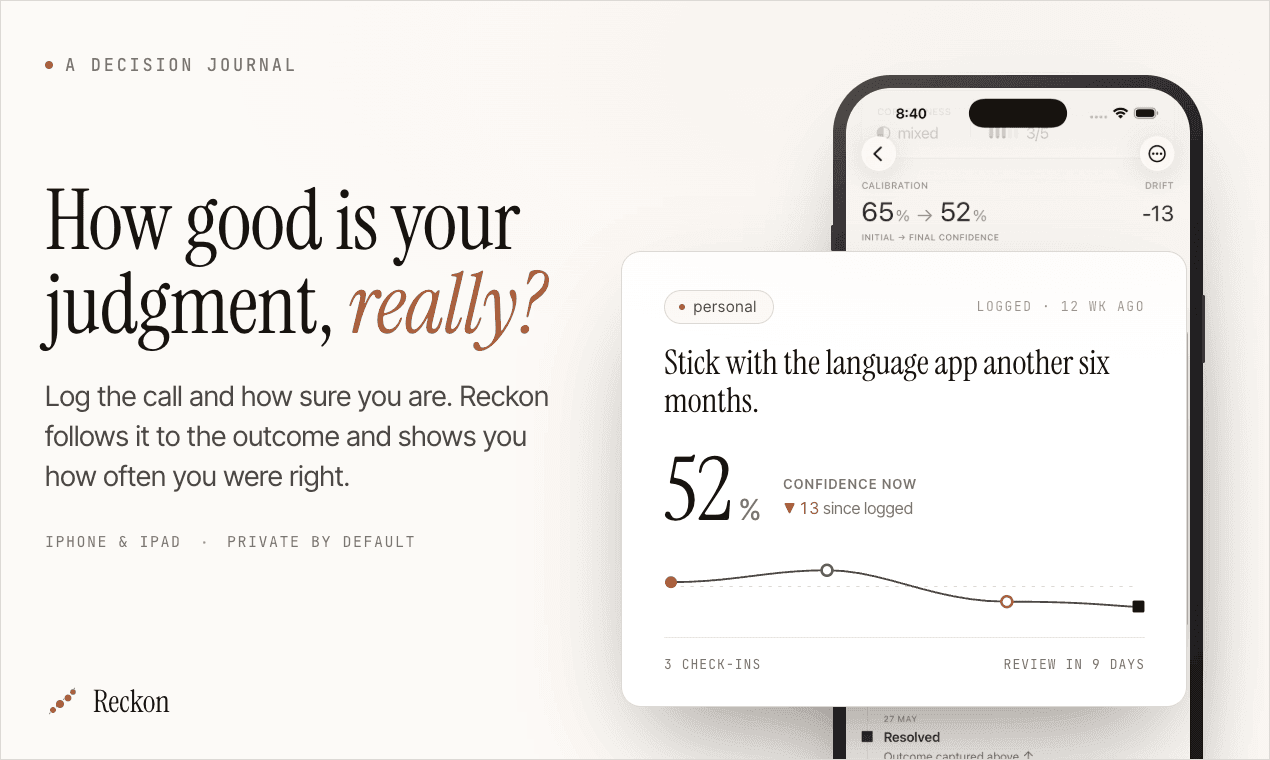
A 30-second check-in nudges that confidence up or down as things change, and every one of them stays on the record.
Image 1 of 1
3. Call it, honestly
Right, wrong or mixed, and how satisfied you are with the call, with your original prediction sitting right there so hindsight can't quietly rewrite it.
Image 1 of 1
4. Then meet your calibration
Do that a few dozen times and the reliability diagram has enough to work with. It plots what you said against what happened, so you can see where you run over-confident and where you run under. Once 15 calls have resolved, with at least 3 in a domain, it splits the picture by domain too.
Image 1 of 1
The second look
Whether a call was right, how you feel about it and whether you'd make it again are different questions, and they don't always agree: a call can turn out exactly as predicted and still feel bad a few months later, or the other way around.
Reckon keeps them apart. You mark the first two when the call resolves, and 60 days later by default (any gap you like, set per decision) it asks the third. The answer stays out of the calibration numbers, so how you feel later never regrades the prediction.
Why it exists
Calibration responds to feedback. Lichtenstein and Fischhoff showed people their hit rate after each round of confidence judgments, back in 1980, and stated confidence moved toward reality, most of the gain after the first round. Weather forecasters put a probability on rain every day, get scored on it the next, and end up almost perfectly calibrated (Murphy and Winkler, 1984). How well that carries over to a job offer is less tested; Do decision journals actually work? has the longer version.
Reckon is that loop without the busywork: you write the prediction before the outcome is known, put a real number on how sure you are, and it does the scoring once the calls resolve.
I've been shipping products for 15 years, making calls under uncertainty the whole time, and I kept score of almost none of them. I thought of doing it by hand for a while, but I never really got into it: nothing to remind me, nothing properly structured. I built Reckon to find out whether my judgment was any good.
Pricing
Reckon
- $3.99once
- Predictions, check-ins and outcomes, read-only once written.
- A second look 60 days after resolution, or any gap you pick.
- The reliability diagram, hit rate and Brier score, with breakdowns by domain.
- Reminders when a check-in, a review or a second look is due.
- iPhone and iPad, synced over your own iCloud, with no account.
The price is for the US; the App Store shows yours.


What Reckon doesn't do
Reckon doesn't check your grading. You mark each outcome yourself and nobody else looks at it, and a vague prediction ("this will probably work out") never counts as a miss, so once the hit rate matters to you, it starts to pay to write them like that.
It also can't say much early on. The diagram carries a "preview" label until 10 calls have resolved and needs a few dozen before it says much, so most of the insights take a while to show up.
FAQ

Reckon
The sooner you start, the more the record can tell you.
Start with the call you're weighing now, before you know how it turns out.
$3.99, once.
Guides
Making better decisions
Frameworks for choosing, and the decision journal that tells you afterwards whether the choosing worked: write down what you expect before the outcome exists.
10 guides